<?xml version="1.0" encoding="utf-8"?>
<?xml-stylesheet href="/feeds/atom-style.xsl" type="text/xsl"?>
<feed xmlns="http://www.w3.org/2005/Atom">
    <id>https://drablog.pages.dev/en/</id>
    <title>Pianpker</title>
    <updated>2026-07-20T12:34:26.678Z</updated>
    <generator>Pianpker with Feed for Node.js</generator>
    <author>
        <name>Drag0nM</name>
        <uri>https://drablog.pages.dev/</uri>
    </author>
    <link rel="alternate" href="https://drablog.pages.dev/en/"/>
    <link rel="self" href="https://drablog.pages.dev/en/atom.xml"/>
    <subtitle>Pianpker — Less, between the lines.</subtitle>
    <rights>Copyright © 2026 Drag0nM</rights>
    <entry>
        <title type="html"><![CDATA[Dead Poets Society]]></title>
        <id>https://drablog.pages.dev/en/posts/dead-poets-society/</id>
        <link href="https://drablog.pages.dev/en/posts/dead-poets-society/"/>
        <updated>2026-07-20T00:00:00.000Z</updated>
        <summary type="html"><![CDATA[The pioneer dies upon the high altar of ideals]]></summary>
        <content type="html"><![CDATA[<blockquote>
<p>The pioneer dies upon the high altar of ideals</p>
</blockquote>
<blockquote>
<p>“We read and write poetry, not because it's cute.&lt;br&gt;
We read and write poetry because we are members of the human race, and the human race is filled with passion.&lt;br&gt;
Medicine, law, business, engineering — these are noble pursuits, and necessary to sustain life,&lt;br&gt;
but poetry… beauty, romance, love — these are what we stay alive for.&lt;br&gt;
The questions of self, of life, keep recurring. The unfeeling multitudes stream past; cities teem with ignorance.&lt;br&gt;
What meaning can be found in living among them — self, life?&lt;br&gt;
The answer is: because you are here.&lt;br&gt;
Because you are here, because the great play continues, and because you may contribute a verse.”</p>
</blockquote>
<p>The yellowed alumni photographs in the display case, those young faces frozen within their frames, resemble butterflies pinned to specimen boards — perfect, silent, forever holding the poised-wing posture society expects. The "Carpe Diem" Keating scrawled on the blackboard's edge was always hastily wiped away by the student on duty.</p>
<p>When Neil placed the thorn crown of <em>A Midsummer Night's Dream</em> upon his head and pulled the trigger in that snowy night, I felt I understood his decision — but I could not accept that he deserved such an ending. This boy who loved theater, who loved literature, used death to complete the most ferocious rebellion against his father's tyranny.</p>
<p>At the story's end, Todd — once the most timid of them all — becomes the first to stand upon his desk. Forced to sign the confession, yet unable to bury their ideals, they are not rebelling when they rise onto their desks. They are bidding their ideals a final farewell. Poetry can awaken numbed senses, and death, too, can sometimes awaken the regimented soul.</p>
<p>When the students stand on their desks to gaze out the window, when Todd recites his verses at the cliff's edge — in these moments, they clearly become fledgling birds attempting to break free from iron cages. And the reality is this: most of us ultimately become Mr. Gromer, prisoners tangled in conjunctions, wandering the labyrinth of "however" and "moreover," forgetting the twilight dying outside the window.</p>
<p>I cannot deny that an unbridgeable chasm lies between the ideal and the real. The road to poetry and distant horizons demands a solid material foundation. When we temporarily compromise for survival on the path toward our ideals, when we have finally earned the ticket to our distant shore through our own labor — will the ideal still be within its expiration date?</p>
<p>Each of us is a specimen torn between two kinds of time: the precise ticking of the clock face, and the irregular tremor within the chest. The former teaches us how to become qualified cogs in the social machine; the latter, in the depths of night, keeps reminding us: you have verses yet unfinished. In this cruel, rational, materialistic society, the idealist always seems naive — always misunderstood.</p>
<p>The pioneer dies upon the high altar of ideals. When every deed is weighed on the scale of utility, how can the soul remain light?</p>
]]></content>
        <author>
            <name>Drag0nM</name>
            <uri>https://drablog.pages.dev/</uri>
        </author>
        <published>2026-07-20T00:00:00.000Z</published>
    </entry>
    <entry>
        <title type="html"><![CDATA[The Hedgehog]]></title>
        <id>https://drablog.pages.dev/en/posts/the-hedgehog/</id>
        <link href="https://drablog.pages.dev/en/posts/the-hedgehog/"/>
        <updated>2026-07-20T00:00:00.000Z</updated>
        <summary type="html"><![CDATA[Our world has a little hope, a little disappointment — I often think so; our world has a little joy, a little sorrow — none can escape]]></summary>
        <content type="html"><![CDATA[<blockquote>
<p>Our world has a little hope, a little disappointment — I often think so; our world has a little joy, a little sorrow — none can escape</p>
</blockquote>
<p>Happy people are always alike, while every unhappy person is unhappy in their own way. Drifting through life, one inevitably encounters both conditions.</p>
<p>And this world is rigid, unkind, and brimming with prejudice. That is why our lives are so barren and weary, so heavy and sorrowful. When those helpless moments arrive — those things we cannot change, those compromises we must make — we become like robins, wandering aimlessly, settling wherever the wind takes us. And one day, when we grow too tired, too exhausted to fly, we land somewhere, activate our self-defense mechanisms, and disguise ourselves as hedgehogs bristling with spines — growing numb, growing lonely, refusing all contact with the outside world in order to avoid being hurt.</p>
<p>Look around you. There are so many hedgehog-like people nearby. They care little for appearances, are not given to conversation, have no zeal for social life, and may even seem mediocre and ineffectual. Their hearts are as hard as steel fortresses, bristling with spines — though most of them are not particularly elegant about it. Yet the world, in truth, is neither as beautiful as we imagine nor as terrible as it appears. It is only that we are so immersed in our own worlds that we fail to notice what is happening outside — who has come, who has gone. Day after day, pain and joy alike dwindle into insignificance.</p>
<p>But someone once said: whatever this world may be, why not be bold with life? For sooner or later, we are bound to lose it. Those innocent dreams. Love that endures until death. The delicacies upon the tongue. The beauty of a landscape that pierces the heart.</p>
<p>As it turns out, life is still very beautiful, after all.</p>
<p>May you, in your solitude, never abandon the pursuit of happiness.&lt;br&gt;
May you, unbeautiful, possess a kind and tender heart.&lt;br&gt;
May you, in poverty, never be impoverished in spirit.&lt;br&gt;
May your future match the measure of your hopes.&lt;br&gt;
May you hold fast to the world of the spirit behind that door.&lt;br&gt;
May you meet someone who can read the elegance behind your spines.</p>
]]></content>
        <author>
            <name>Drag0nM</name>
            <uri>https://drablog.pages.dev/</uri>
        </author>
        <published>2026-07-20T00:00:00.000Z</published>
    </entry>
    <entry>
        <title type="html"><![CDATA[Notes of a Crocodile]]></title>
        <id>https://drablog.pages.dev/en/posts/crocodile-notes/</id>
        <link href="https://drablog.pages.dev/en/posts/crocodile-notes/"/>
        <updated>2025-06-18T00:00:00.000Z</updated>
        <summary type="html"><![CDATA[Until the person I am begins to mean something to you]]></summary>
        <content type="html"><![CDATA[<blockquote>
<p>Love resides in no ending</p>
</blockquote>
<p>“She was my only passage for breathing into the outside world.”&lt;br&gt;
That was the first thing I knew about this book.&lt;br&gt;
Because of that line, I came to read it.</p>
<p>Reading Qiu Miaojin is dangerous—&lt;br&gt;
or so the internet says.&lt;br&gt;
Her words begin to hurt the moment you open the book.&lt;br&gt;
The “I” of the story loves with a terrible lucidity;&lt;br&gt;
love is torn open, crushed, and laid before us—naked, withholding nothing.&lt;br&gt;
On my first reading, I did not even know&lt;br&gt;
what she was trying to say.</p>
<p>When I finished the book, still absorbed in its protagonist,&lt;br&gt;
I picked up the dust jacket I had removed on the pretext that it got in the way.&lt;br&gt;
“Died at only twenty-six.”&lt;br&gt;
Only then did my heart ache in the most literal, physical sense.</p>
<p>This was the first book about love I had ever read;&lt;br&gt;
I had ventured so little into this terrain.&lt;br&gt;
I spent half an hour merely trying to shape this piece,&lt;br&gt;
not knowing how to begin, or how writing might undo the tragedy.</p>
<p>“Her acceptance of me amounts to a denial of the self I deny.”&lt;br&gt;
Strange: I understood that knotted sentence the first time I read it.&lt;br&gt;
I am always denying myself.&lt;br&gt;
As the book says:&lt;br&gt;
“The whole world can love me; it is useless. I hate myself.”&lt;br&gt;
Sometimes I do hate myself—for not being good enough, not being strong enough.&lt;br&gt;
Yet someone loves me and, with a single sentence, can soothe the conflict I have worried at all day.&lt;br&gt;
I fold myself into a letter that refuses to be unfolded,&lt;br&gt;
while someone gently lifts my edges with the tweezers of their gaze.</p>
<p>“An embrace is a long wound, a tearless song of parting.”&lt;br&gt;
I like embraces. I even crave them.&lt;br&gt;
Of course, it depends on the person. Wanting physical touch always feels somehow shameful; at least, I have not yet learned how to ask.</p>
<p>To fall in love with women is easy.&lt;br&gt;
Qiu Miaojin is a woman who knows how to love women.&lt;br&gt;
I am not. This has nothing to do with desire;&lt;br&gt;
it is simply that, at the level of love, women are always compelling.&lt;br&gt;
What draws us is prettiness, and beauty.&lt;br&gt;
What is the difference between the two?&lt;br&gt;
Prettiness is a gift bestowed by heaven and by our genes;&lt;br&gt;
beauty is a miracle we create for ourselves.</p>
<p>The chains that bind certain souls&lt;br&gt;
cannot be undone by the meager, unfinished contents of this one life.&lt;br&gt;
Then remain entangled with me,&lt;br&gt;
until the person I am begins to mean something to you.</p>
]]></content>
        <author>
            <name>Drag0nM</name>
            <uri>https://drablog.pages.dev/</uri>
        </author>
        <published>2025-06-18T00:00:00.000Z</published>
    </entry>
    <entry>
        <title type="html"><![CDATA[Children of Men]]></title>
        <id>https://drablog.pages.dev/en/posts/children-of-men/</id>
        <link href="https://drablog.pages.dev/en/posts/children-of-men/"/>
        <updated>2025-06-18T00:00:00.000Z</updated>
        <summary type="html"><![CDATA[Only the most devout humanity can, like a deus ex machina, redeem everything]]></summary>
        <content type="html"><![CDATA[<blockquote>
<p>Only the most devout humanity can, like a deus ex machina, redeem everything</p>
</blockquote>
<p>In 2006, <em>Children of Men</em> was released — the year I was born. Back then, Alfonso Cuaron could scarcely have imagined that discussions around this film would become as "correct" as they are today.</p>
<p>I want to focus on the film's subtly expressed religious dimension. In truth, "religious sensibility" and "religion" are not the same thing. Like many people, I am averse to religion because of its煽动性, the inglorious role it has played throughout history, and its stubborn, obscurantist obstruction of modern social progress. But what I call "religious sensibility" is, to me, the most primal form of beauty and awe. It is not that such images are beautiful because of religion; rather, because such images are beautiful, they were woven into religion. A thread of hope in a desolate world, the birth of new life — these are things every one of us wishes to touch, embrace, and even sacrifice for. In the film, the religious sensibility is merely a mode of expression, not the theme. I hope viewers will not project their distaste for religion onto the film, thereby losing the capacity for appreciation and reflection.</p>
]]></content>
        <author>
            <name>Drag0nM</name>
            <uri>https://drablog.pages.dev/</uri>
        </author>
        <published>2025-06-18T00:00:00.000Z</published>
    </entry>
    <entry>
        <title type="html"><![CDATA[Contact]]></title>
        <id>https://drablog.pages.dev/en/posts/contact/</id>
        <link href="https://drablog.pages.dev/en/posts/contact/"/>
        <updated>2025-06-18T00:00:00.000Z</updated>
        <summary type="html"><![CDATA[If the pursuit of truth is held sacred, then scientists and preachers can love one another too]]></summary>
        <content type="html"><![CDATA[<blockquote>
<p>If the pursuit of truth is held sacred, then scientists and preachers can love one another too</p>
</blockquote>
<p>Adapted from Carl Sagan's <em>Contact</em>, the film shifts away from the novel's focus on women's social experience and instead discards most of its hard science fiction outer shell to turn toward the question of science and religion.</p>
<p>So I want to explore science and religion against this near-"deus ex machina" backdrop. I was previously acquainted with the work of American philosophers like Wilfrid Sellars, who proposed "scientific realism" — the view that "theoretical entities of science genuinely exist, emphasizing the objectivity of scientific methods, rules of inference, and concepts." What is obvious is that this raises a further question: if science is real, how can we know this real science? It is like a Mobius strip, endlessly looping, and the middle term is religion. One might say that religion is both the beginning of science and an obstacle to its development. The film shows the extreme frenzy religion can provoke around scientific questions — some people celebrate, others commit suicide. This is the manifestation of encountering religious symbols, and it can also be seen as a kind of worldview. The film presents three such worldviews: science of pure reason, a conciliatory blend of the two, and religion of pure emotion.</p>
<p>In the final hearing, the director has the protagonist, Arroway, shift from absolute rationality to pure emotion, and has a believer speak the line: "But we both share the same goal — the pursuit of truth."</p>
<p>In this respect, the film's central thesis comes into full view: <strong>"But we both share the same goal — the pursuit of truth."</strong></p>
]]></content>
        <author>
            <name>Drag0nM</name>
            <uri>https://drablog.pages.dev/</uri>
        </author>
        <published>2025-06-18T00:00:00.000Z</published>
    </entry>
    <entry>
        <title type="html"><![CDATA[Hacksaw Ridge]]></title>
        <id>https://drablog.pages.dev/en/posts/hacksaw-ridge/</id>
        <link href="https://drablog.pages.dev/en/posts/hacksaw-ridge/"/>
        <updated>2025-06-18T00:00:00.000Z</updated>
        <summary type="html"><![CDATA[A true hero dares to face death with nobility]]></summary>
        <content type="html"><![CDATA[<blockquote>
<p>A true hero dares to face death with nobility</p>
</blockquote>
<p>After <em>Apocalypto</em> in 2006, Mel Gibson waited a decade before returning to the director's chair with <em>Hacksaw Ridge</em>. <em>Braveheart</em> is proof enough of Gibson's ability, but some critics have dismissed <em>Hacksaw Ridge</em> as excessively sentimental, as beautifying war. In truth, though it may seem tamer compared to films that emphasize the horror of war — <em>The Hurt Locker</em>, <em>Billy Lynn's Long Halftime Walk</em> — when Doss first sets foot on the battlefield, Gibson stages the most harrowing, blood-soaked images in the entire film to convey the brutality of war. And that reveals his intent.</p>
<p>This is a film about war, and also a film about faith.</p>
<p>Faith is the foundation upon which our spiritual existence rests, the tool with which we balance material desire. Most people choose a faith that aligns with mainstream social values, one that makes survival easier. But if we choose a faith that deviates from the mainstream, the effort we must expend to defend it is destined to be greater, and the path will be rough and treacherous.</p>
<p>Were it not for risking his life under a hail of bullets to save dozens of men and becoming a universally revered hero, Doss would have been seen by others as just another oddball: a soldier who would rather go to military prison than touch a rifle. Those who did not understand him would simply dismiss this faith as cowardice.</p>
<p>Each person's unique experiences shape, to some degree, our different faiths, and these varied faiths make us into different people. As a child, Doss struck his brother unconscious with a brick during a fight and then, as if receiving a divine revelation, looked up to see one of the Ten Commandments on the wall: Thou shalt not kill. Later, as a young man, he raised a gun to his drunken, abusive father, and though he never pulled the trigger, he felt the terrifying force of his own violent impulses. These experiences steeled his resolve to never touch a weapon again. The differences in our experiences make each of us, in the eyes of others, a strange creature of some kind.</p>
<p>It is curious, when you think about it — faith seems not quite rational, sometimes devoid of logic, yet it is precisely this incompleteness of reason that makes faith the proof of our free will. More often than not, the reasons we cling to our faith are fragile, just barely enough to convince ourselves — no one else. That is why Doss did not become a saint preaching nonviolence to the world, nor did he try to stop others from killing. "Thou shalt not kill" was a principle he set for himself, and himself alone (it also happened to be a tenet of his Seventh-day Adventist faith, though there is no contradiction). These convictions make us into people unlike others, and they allow us to feel ourselves as independent individuals, not merely cogs running on society's predetermined program.</p>
<hr />
<h2>Afterword: Beyond Desmond Doss</h2>
<p>Although Gibson uses the film to showcase Doss's heroic deeds, holding fast to one's faith has never been something one can be simply optimistic about. The film remains somewhat idealized in its portrayal of the conflict between individual conviction and collective order. We should recognize that, compared to Doss, far more people who fought to defend their faith ultimately perished or capitulated, never living to see the moment when their voice could at last be heard.</p>
<p>It is precisely because Doss is one of those rare individuals in whom the light of faith shone through that his story deserves to be told and retold. To face death with nobility requires the courage to place life and death entirely aside. For Doss, the battle between faith and discipline was fierce enough; life itself could only come a distant third. So when the captain asked him what he could do for this war, his answer was: I am already prepared to give my life. The captain told him: your life won't help us win this war. But I would reply: the lives he saved — those will.</p>
]]></content>
        <author>
            <name>Drag0nM</name>
            <uri>https://drablog.pages.dev/</uri>
        </author>
        <published>2025-06-18T00:00:00.000Z</published>
    </entry>
    <entry>
        <title type="html"><![CDATA[In the Heat of the Sun]]></title>
        <id>https://drablog.pages.dev/en/posts/in-the-heat-of-the-sun/</id>
        <link href="https://drablog.pages.dev/en/posts/in-the-heat-of-the-sun/"/>
        <updated>2025-06-18T00:00:00.000Z</updated>
        <summary type="html"><![CDATA[Looking back, the dazzling sunlight is no more]]></summary>
        <content type="html"><![CDATA[<blockquote>
<p>Looking back, the dazzling sunlight is no more</p>
</blockquote>
<p>First, a note: I watched the 2022 French restoration of <em>In the Heat of the Sun</em>, running 140 minutes. All observations below proceed from that version. Jiang Wen's films invariably arrive laden with allegory — <em>Let the Bullets Fly</em>, <em>The Sun Also Rises</em>, and the like. Limited as I am by my historical knowledge, I will not venture into that territory. I will only discuss one character: Gulunmu.</p>
<p>From beginning to end, Gulunmu appears as a figure marked by intellectual disability. He is a character of the most minor order, ostensibly deployed to convey the texture of the era, yet he threads through the entire film. In the beginning, whenever friends from the compound called out "Gulunmu," he would answer "Oppa!" — the Korean password-exchange phrase from the then-popular revolutionary opera <em>Raid on the White Tiger Regiment</em>.</p>
<p>The brawl in the middle act is also sparked by an affront against him. This fight can be read in two ways: as the director's device to reinforce the fraternal bond among the main characters at that moment, or as a mechanism to further modulate the characters (subtly sidelining the first-generation female lead) and adjust the film's pacing. From this point on, Gulunmu, too, begins to fade from view.</p>
<p>Nearing the end, Ma Xiaojun, now estranged from his brothers, encounters Gulunmu in the compound. He offers no comfort to the weeping Gulunmu, merely brushing past. The fact that the director summons Gulunmu back at this point, after his long absence, underscores the character's singular role.</p>
<p>At last, the protagonists have left that era and entered a new society. Through a car window, they spot Gulunmu and are flooded with memories. They call out, "Gulunmu! Gulunmu!" But Gulunmu, walking across the bridge, answers with only two words: "Dumbass."</p>
<p>Watch closely, and you will notice that Gulunmu's staff is never far from his side — even the film's central conflict erupts because his staff was snatched away (as mentioned above) — and it remains with him to the very end. The protagonists, by contrast, have been utterly transformed by time. Gulunmu still carries his staff, but the words that leave his mouth are no longer "Oppa!" — they are the vulgar retort of a new, crass age: "Dumbass." Connecting this with the earlier sequence, where the grown men sit drinking and chatting in the car, trying to recapture shadows of their youth, Liu Yiku — now himself mentally broken — points outside and spots that character who traverses the entire era. One word marks one age. From inside the car, Ma Xiaojun's group keeps shouting the name they teased him with as boys, expecting him to answer "Oppa!" as before. But the two words Gulunmu hurls back declare that the era has changed. It is time to leave boyhood behind and return to reality.</p>
]]></content>
        <author>
            <name>Drag0nM</name>
            <uri>https://drablog.pages.dev/</uri>
        </author>
        <published>2025-06-18T00:00:00.000Z</published>
    </entry>
    <entry>
        <title type="html"><![CDATA[Nowhere Special]]></title>
        <id>https://drablog.pages.dev/en/posts/nowhere-special/</id>
        <link href="https://drablog.pages.dev/en/posts/nowhere-special/"/>
        <updated>2025-06-18T00:00:00.000Z</updated>
        <summary type="html"><![CDATA[The human soul is like a bee, gathering pollen called "love" from every flower, brewing it into honey — and when enough pollen has been gathered, it flies away from this body…]]></summary>
        <content type="html"><![CDATA[<blockquote>
<p>The human soul is like a bee, gathering pollen called "love" from every flower, brewing it into honey — and when enough pollen has been gathered, it flies away from this body…</p>
</blockquote>
<p>You may wonder: does not the bee's harvest then vanish and fade along with the soul's departure?</p>
<p>What I wish to say, my friend, is this —</p>
<p>When you revisit those moments of happiness, are you not, at that very instant, opening a jar of honey marked with the label "love"?</p>
]]></content>
        <author>
            <name>Drag0nM</name>
            <uri>https://drablog.pages.dev/</uri>
        </author>
        <published>2025-06-18T00:00:00.000Z</published>
    </entry>
    <entry>
        <title type="html"><![CDATA[The Dark Knight]]></title>
        <id>https://drablog.pages.dev/en/posts/the-dark-knight/</id>
        <link href="https://drablog.pages.dev/en/posts/the-dark-knight/"/>
        <updated>2025-06-18T00:00:00.000Z</updated>
        <summary type="html"><![CDATA[The best comic book adaptation, but not the greatest film]]></summary>
        <content type="html"><![CDATA[<blockquote>
<p>The best comic book adaptation, but not the greatest film</p>
</blockquote>
<p>I have now watched this film three times. In truth, the substance I drew from it on my first viewing is essentially all there is. Nolan excels at constructing grand, spectacular, even epic imagery — which is precisely why he is so enamored with the IMAX format. Yet beyond the beauty and visceral impact of those images, the film offers little else, nothing genuinely novel. The Joker's performance is quite remarkable, but not enough to elevate this film to a pedestal it does not deserve. A Taiwanese critic once described his performance in self-destructively vivid terms — "over-immersion becomes spirit possession" — but I would say it has not gone quite that far. In the history of cinema, he is not the first to perform in this manner, nor is the Joker an unprecedented or unsurpassable character. It was Heath Ledger's death that mythologized the role.</p>
<p>Some say this film surpasses <em>The Godfather</em>. To me, the two are simply not comparable. <em>The Godfather</em> has no special effects; it leans entirely on its actors, its story, and their performances. The reason this film sits so high atop the IMDb rankings is, most likely, a matter of being in the right place at the right time. The power of Web 2.0 is immense, and <em>The Dark Knight</em> rode that wave at its peak. Add to that Heath Ledger's extraordinarily outstanding performance and his tragic death, with <em>Brokeback Mountain</em> already a jewel in his crown, and the film's score was skyrocketed from the outset.</p>
]]></content>
        <author>
            <name>Drag0nM</name>
            <uri>https://drablog.pages.dev/</uri>
        </author>
        <published>2025-06-18T00:00:00.000Z</published>
    </entry>
    <entry>
        <title type="html"><![CDATA[A Brighter Summer Day]]></title>
        <id>https://drablog.pages.dev/en/posts/a-brighter-summer-day/</id>
        <link href="https://drablog.pages.dev/en/posts/a-brighter-summer-day/"/>
        <updated>2025-05-28T00:00:00.000Z</updated>
        <summary type="html"><![CDATA[The death of ideals — when the weak draw a blade, they can only strike at those even weaker]]></summary>
        <content type="html"><![CDATA[<blockquote>
<p>The death of ideals — when the weak draw a blade, they can only strike at those even weaker</p>
</blockquote>
<p>Edward Yang's films have long been described as a "scalpel" dissecting Taiwanese society, and his masterful grasp of detail — geographical, historical, cultural — more than justifies that reputation. Across his "Taipei Trilogy" and "New Taipei Trilogy," Yang anatomized Taiwan from multiple angles, yet it is <em>A Brighter Summer Day</em>, which stands apart from those two cycles, that remains his sharpest scalpel of all.</p>
<p>After spending nearly ten hours with this film — the original cut, analyses, background research, and studies of the director — I have at last arrived at a preliminary assessment. The four-plus hours of the original cut made me realize, for the first time, how perfectly Ann Hui's words apply: "Some things, when they cannot be written down, must be made into a film." If this story were rendered in prose alone, it might truly have lost all flavor.</p>
<p>Though limited by my own ability, I hesitate to delve too deeply into history, yet out of respect for the film I offer this brief background: the story unfolds in the 48th year of the Republic of China — that is, 1959 — a decade after the Nationalist government fled to Taiwan, during the period of martial law. Over two million people had retreated to the island, and their children were coming of age, a new generation living under an extraordinary convergence of history and geography. Those two million came from every corner of China, speaking a bewildering mosaic of dialects, caught in immense cultural collisions that left them utterly adrift (partially adapted from the film's opening narration).</p>
<p><em>A Brighter Summer Day</em> is a grand epic, only it bears too modest a name. Though the title sets the narrative through-line, the film's scope is vastly broader, focused on an entire era — it is an interweaving and collision of multiple groups and classes. Chai Jing's interview exposed the story behind Yao Jiaxin; that was enough to stir our empathy and prompt self-reflection. But what Edward Yang exposed was the pathology of an entire era behind people like Yao Jiaxin — the shared helplessness of small individuals crushed beneath an immense social machine, under a dark political repression, behind impenetrable class barriers. If you are a nobody, no matter how you resist or struggle, you cannot make the slightest dent in this rigidly stratified social structure. The resistance of the weak can only wound those even weaker, and in the end, destroy themselves along with them. That is why Xiao Si'r's knife thrust at the film's end has been incisively summarized by a Douban reviewer as "a knife from the weak to the weak." That blade was Xiao Si'r's despair at his goddess's betrayal and the utter death of their love, but it was also a self-immolating blow of rage from the weak, crushed by an oppressive society. That one knife destroyed two young people and the families behind them — a crime of passion born from love turned to hatred, yes, but also a muffled, anguished cry of the weak in the depths of despair.</p>
<p>Through the content, I saw a central theme: <strong>the death of youthful ideals</strong>.</p>
<p>The reason I love <em>A Brighter Summer Day</em> and consider <em>In the Heat of the Sun</em> its lesser is precisely that Edward Yang, with cool precision and meticulous care, lays bare the entire process of a young man's ideals crumbling to dust.</p>
<p>A man's first idol is always his "father." For Xiao Si'r, his father was a towering figure of integrity and fire. The first time Father is summoned to the school office to meet the teacher, he argues passionately, insisting the examination system is flawed. Xiao Si'r stands behind his father, silent, but his heart brims with admiration. On the way home, Father tells him to have backbone. Then martial law tightens its grip on Taiwan. Father is called in to write confession materials, day after day. A month passes, and Father has aged immeasurably — the old heroic spirit gone, reduced to a timid, taciturn shell. The image of the father collapses.</p>
<p>A man's second idol is his "brother" — the code of fraternal loyalty, through fire and flood. This is why Xiao Si'r, though enamored with Ming, also reveres Honey. Honey is a true brother who lives by the code. But Honey's old-school code of the streets has already become obsolete, and he dies in the schemes of the military-village gang. This lamp of righteousness is extinguished.</p>
<p>"Losing the whole world means nothing, as long as I can be with you" — that is the anthem of every naive love. A man's third comfort is love, the source of his courage and strength, the courage with which he stands against the entire world. So when Ming finally speaks the words, "I am just like this world — I cannot be changed," the last lamp in Xiao Si'r's heart goes out. He can find no more exits, no more supports, and begins to drift.</p>
<p>He chooses violence, murder, and then spends half his life in prison.</p>
<p>In our youth, driven by instinct, we hate evil with fierce conviction, draw sharp lines between love and hate, cannot tolerate a single grain of sand in our eye, and even believe that whatever exists is unreasonable and must be overthrown and destroyed. Yet sooner or later, we must step into society. Reality is always crueler than what the mind imagines; the world is never as perfect as we dreamed. Gradually, we come to accept that "whatever exists is reasonable," and then we feel the helplessness — and more importantly, we discover that, beyond shattering a wine bottle, there is truly nothing we can change.</p>
<p>I might console myself with the thought: I am only seventeen; I still have time to use a vibrant life to refute this pessimism of yours. But Yang-Yang's line in <em>Yi Yi</em> — "I've grown old too" — struck me down completely. It turns out I can no longer escape. The same is true of <em>A Brighter Summer Day</em>. The ages and thoughts I have lived through, the ugliness and helplessness I have witnessed — all of it tells me that I was entangled in these weighty questions long ago. Since there is no avoiding them, can one ever break free? Perhaps the choice made after that long silence is the choice of a lifetime, and the true meaning of "coming of age."</p>
]]></content>
        <author>
            <name>Drag0nM</name>
            <uri>https://drablog.pages.dev/</uri>
        </author>
        <published>2025-05-28T00:00:00.000Z</published>
    </entry>
    <entry>
        <title type="html"><![CDATA[Hidden Figures]]></title>
        <id>https://drablog.pages.dev/en/posts/hidden-figures/</id>
        <link href="https://drablog.pages.dev/en/posts/hidden-figures/"/>
        <updated>2025-05-28T00:00:00.000Z</updated>
        <summary type="html"><![CDATA[The importance of being the first]]></summary>
        <content type="html"><![CDATA[<blockquote>
<p>"The importance of being the first"</p>
</blockquote>
<p>Released in 2016, this film is a relatively young one among those I have watched. From the budding emergence of "political correctness" in the 1990s to the time of its release, the concept had already taken deep root. Naturally, the film's merits cannot be dismissed on that account.</p>
<p>As the opening suggests, the entire film revolves around the idea of "the importance of being the first." Whether in the dialogue between characters or the authentic historical backdrop, this idea is emphasized at every turn. In fact, by this point the director has already laid his perspective on the questions of racial emancipation and equal rights completely bare.</p>
<p>If Foucault treats gender as an outcome, then Melfi works backward from effect to cause, arriving at a particular insight: all inequality, all antagonism, is at its core constituted by differences in demonstrated ability. And thus, what "the importance of being the first" expresses is precisely the solution to this disparity. Only by compensating for the consequences produced by disparities in demonstration can power be redistributed. In the film, the female protagonists achieve precisely this compensation through sheer effort, even demonstrating abilities superior to the norm, thereby easing — and even eliminating — racial segregation. For people are ever drawn to strength. Yet the film also shows that after the scales of power have tipped, the disadvantaged side must expend many times the effort to bring them back into balance. This has nothing to do with gender; it is human nature. Those who benefit from the status quo will always find ways to protect their privileges, regardless of whether they are men or women.</p>
<p>Through the film, I look out at life. Factions, antagonism, utter chaos, set against the backdrop of a debased modern journalism. Everything has strayed from classical understanding and turned absurd. Under such circumstances, will the equal rights you seek truly arrive on schedule? Or rather — can rights obtained through absurd means ever truly endure? I am reminded: "These violent delights have violent ends."</p>
<p>Seen this way, I may as well keep looking toward the film.</p>
]]></content>
        <author>
            <name>Drag0nM</name>
            <uri>https://drablog.pages.dev/</uri>
        </author>
        <published>2025-05-28T00:00:00.000Z</published>
    </entry>
    <entry>
        <title type="html"><![CDATA[Robot Dreams]]></title>
        <id>https://drablog.pages.dev/en/posts/robot-dreams/</id>
        <link href="https://drablog.pages.dev/en/posts/robot-dreams/"/>
        <updated>2025-05-28T00:00:00.000Z</updated>
        <summary type="html"><![CDATA[The part of me that you changed will stand with me forever, in your place]]></summary>
        <content type="html"><![CDATA[<blockquote>
<p>The part of me that you changed will stand with me forever, in your place</p>
</blockquote>
<p>On March 11, 2024, at the 96th Academy Awards ceremony in Los Angeles, Hayao Miyazaki's <em>The Boy and the Heron</em> took home the Oscar for Best Animated Feature. Among the nominees was <em>Robot Dreams</em>, adapted from Sara Varon's graphic novel of the same name. On Douban, however, the two films' standings could hardly be more opposite.</p>
<p>Of the source material, Pablo Berger — who had never directed an animated film before — said: "I had never cried reading a graphic novel before, and in that moment, I thought: I have to turn Sara's book into an animated film."</p>
<p>He succeeded.</p>
<p>And so, what follows is a personal dissection of this animated children's film made for adults.</p>
<hr />
<h2>Why is <em>Robot Dreams</em> so rich in meaning?</h2>
<p>Compared to other animated films, <em>Robot Dreams</em> possesses one particularly striking feature — it contains not a single line of dialogue. If language carries emotion, as the most straightforward vehicle of emotional expression, then <em>Robot Dreams</em>, as a color silent film, conveys emotion to us even more directly through the characters' expressions and gestures. It is precisely by stripping away the subjective mediation of language itself, by presenting emotion directly before your eyes rather than confining it with words, that the film achieves its remarkable interpretative richness. In the eyes of ten thousand viewers, there may well be ten thousand versions of Robot and Dog.</p>
<p>Moreover, unlike romantic films that often conclude with didactic or summarizing lines of dialogue, the elision of language in this film, combined with its interpretative openness, adds a layer of ineffable emotion at the ending — one that can only be savored, long and silently, in the depths of the heart.</p>
<p>In keeping with animated film convention, <em>Robot Dreams</em> chooses a dog and a robot as its protagonists. Animals and robots are perennial favorites of children's animation — for their cuteness, their magical quality, and other such reasons. But viewed through this film's lens, there is another way to understand this choice: it is by this very means that the film completely erases the two characters' gendered characteristics. The director maximizes the species difference between the two leads as much as possible, and adopts a Chaplinesque silent-film style — all of which suggests he does not want the audience to apply the ready-made frameworks of human society — lovers, best friends, brothers — to crudely and reductively define this naturally blossoming, beautiful connection, thereby obscuring what the film truly wishes to explore: the nature of intimate relationship itself. As a result, the bond between the two can be interpreted in multiple ways — it may be seen as romantic love, or understood as friendship. The different perspectives from which the content unfolds thus produce the rich interpretability mentioned above.</p>
<hr />
<h2>What is <em>Robot Dreams</em> about?</h2>
<p>If you watch <em>Robot Dreams</em> closely, you will discover that beneath its surface theme — shared with films like <em>Love Me If You Dare</em>, <em>La La Land</em>, and <em>We Made a Beautiful Bouquet</em>, the theme of "a broken mirror not mended" — there lies an immense narrative archetype called "intimate relationship."</p>
<p>When watching the aforementioned films of this type, we often merely lament the caprices of fate and the cruelty of circumstance; few of us seek to understand the magnitude of emotional transformation experienced by those living inside the story. What sets <em>Robot Dreams</em> apart is that, through the dual perspectives of one dog and one robot, it grants us the chance to inhabit their experience — to feel the wordless heartbreak and reluctance when an intimate bond is forcibly severed.</p>
<hr />
<h2>Everything about this film is hidden within these few dreams</h2>
<p>After their separation, the Robot has three dreams, and these three dreams seem to represent the stages of emotional change one undergoes after being forced apart.</p>
<p><strong>The First Dream</strong>: The Robot dreams of breaking free from the beach and finding the door to Dog's apartment. Just at the moment of knocking, the dream shatters. He thought three rabbits had kindly come to his rescue, but upon waking he discovers they are savagely sawing off his leg and prying off his toes to patch their boat — his first visceral lesson in the cruelty and danger of the outside world. This dream represents <strong>bewilderment</strong>. After a sudden separation from someone you love, the very first feeling is confusion and disbelief — doubting that any of this is real, believing it is only a matter of having lost each other by accident, and that once you find the other, this bond can continue.</p>
<p><strong>The Second Dream</strong>: Dog has forgotten him and found a new robot — and this newcomer bears him ill will. He can only hide, flustered, embarrassed, sorrowful, behind a trash can, as though he, too, has become a piece of refuse no one cares for. In just a few expressions, the Robot runs the gamut from shock to disbelief to heartbreak. I believe this dream represents <strong>terror</strong>. After a period of waiting, realizing that the other truly does not want to come back for you — then comes the shock, the fear, the heartbreak. Shock that a bond you thought could never break has reached its end. Fear that a "newer, better" presence will replace you. Heartbreak that while you are still waiting and searching in anguish, the other has long since cast you from their mind.</p>
<p><strong>The Third Dream</strong>: Spring sunshine, a rainbow suspended high, flowers dancing around the Robot in celebration, forming a procession in the shape of the protagonist. This time, the Robot is utterly convinced he will reunite with Dog — but reality plays yet another colossal trick on him. The entire city is nothing but a false backdrop. When it collapses with a roar, the ultimate contrast of light and dark, warmth and cold, truth and illusion declares that the Robot has now sunk into deep <strong>despair and fear</strong>. This dream represents the desolation that comes after accepting the outcome.</p>
<p>Everything has settled. Though the other still appears in dreams, though those tender moments still return in sleep, it is all nothing more than yesterday's phantoms. The beautiful sunlight and music bring only a fleeting solace within the dream; when the dream ends, reality is as cold as ever.</p>
<p>At the same time, while the Robot struggles through separation, Dog, too, endures the pain of parting.</p>
<p>The new companion in this dream is the Snowman, whom Dog has given life to. The Snowman is a born star — everywhere he goes, he is the center of attention, while Dog, by contrast, is unwelcome. This Snowman is an inverse projection of Dog's inner self. In life, Dog is withdrawn, insecure, and lacking in confidence, afraid to speak to strangers, locking the door of his apartment with multiple bolts. The Snowman's image seems to be what Dog longs for — a desire to bid farewell to his former self and become an ideal, better person. And yet, the Snowman's face, in the end, transforms into the Robot's.</p>
<p>This also suggests that, through his shared life with the Robot, Dog's way of thinking has been changed. The days spent with the Robot brought sunlight into his gray existence, and he gradually became someone who lives more positively.</p>
<p>And after the Robot awakens from his dream, a mother bird comes to him. He watches her bring new life into the world, and toward this new life — especially that one differently colored little bird — the Robot extends the same careful nurture that Dog once showed him when teaching him how to live. Later, when he finds a new companion, he remembers how he once gripped Dog's hand too tightly by accident, and so holds his new companion's hand all the more gently. Beautiful love, in truth, is like this: it is not that I could not live a single second without you, but that because of you, I have become a better version of myself.</p>
<p>Both of these deeply moving relationships in the final two dream sequences are variations upon the bond between Dog and Robot.</p>
<p>Just as the title <em>Robot Dreams</em> suggests — dreams do not last forever. And this film shows us what comes after waking: how to carry those beautiful memories forward and live a better life. This is what elevates it above other films that share "intimate relationship" as their narrative archetype. It does not merely depict the dissolution of an intimate bond; it chooses, with even greater scope, to elaborate on the story that comes after the separation. It leads us into the depths of memory, to look back at those passersby who left their footprints upon our fickle fates, and to see how, through love and companionship, they forged the unique individuals we are today.</p>
<hr />
<h2>Why couldn't Dog rescue the Robot?</h2>
<p>Children's animated films tend to render their characters in flat, simplified strokes — what are generally called "flat characters." Creators often seize upon a character's animal traits and exaggerate or distort them to streamline personality, making it black or white. Whether in <em>Tom and Jerry</em> or <em>Zootopia</em>, this approach is the norm. Unusually, <em>Robot Dreams</em> preserves its characters' basic animal natures while choosing to complicate them, infusing them with the fullest possible measure of humanity. So, beyond Dog's tail-wagging when excited and his reliance on smell to find the Robot, we rarely see him display the raw animality of a dog. On the contrary, his patterns of thought, his behavioral modes, and his emotional expressions are all remarkably close to those of a human being. As director Pablo Berger said in an interview: "In a lot of animated films, the way characters act or react is very exaggerated. I wanted to dial it down and have the characters perform truthfully, like real people."</p>
<p>What could clearly have been an avoidable accident becomes, like all the joys and sorrows of this world, a matter of fate's gears not always meshing and turning precisely as one wishes. More often than not, it is through a succession of near misses and crossed signals that we, along with our loved ones and dearest friends, are pushed in different directions by fate's invisible hand, drifting further and further apart until we fade from one another's lives entirely. But is that truly the case? Perhaps it is precisely the personality traits revealed in the details that make this accident not merely contingent but inevitable.</p>
<p>The first time Dog takes the Robot out, they encounter some punk rockers. Faced with the Robot's warm greeting, the youngsters reply with a middle finger. Afraid of trouble, Dog drags the Robot away in a panic. In the chaotic subway station, where fare evasion is rampant, Dog still insists on buying a ticket before entering. On the bus, Dog gingerly takes a snack from his bag, afraid of displeasing the driver…</p>
<p>Detail after detail points to a personality that is cautious, timid, sensitive, and rule-abiding. And it is precisely this personality that precipitates their first separation. So, to facilely brand Dog with labels like "didn't love the Robot enough" or "fickle" is a shallow judgment; it cannot be denied that Dog poured genuine effort into this intimate bond. After all, not everyone has a god's-eye view. He is like any ordinary person caught in an intimate relationship crisis in the human world — what looks to an outside observer like "not enough" may, for him, have been "everything I had."</p>
<p>Likewise, at the film's end, the two parallel threads of fate intertwine once more. The Robot sees Dog, just across the street, with his new companion. Memories of days gone by flood his mind, and he has one last waking dream: dashing down the stairs, racing into the street, embracing Dog. Once, he would have done exactly that. But now he has a new body, a new family — and Dog, too, has new companionship. So, after the dream fades, he chooses to press play. Accompanied by that familiar theme song, he dances one last duet with Dog — across the distance, across the street.</p>
<p>As the director has said, <em>Robot Dreams</em> is not a children's film. Only those who have truly experienced loss can bear the weight of this bittersweet ending.</p>
<hr />
<h2>Beyond the review</h2>
<p>There is a viewpoint that goes: "The relationship between Dog and Robot was inherently unequal. Robot was a commodity Dog purchased to relieve boredom — an accessory — while Dog was Robot's entire world. Such a relationship predetermined the outcome of their separation. Perhaps Dog was already using the maximum of his capacity to love, but the purposefulness of the relationship determined the result."</p>
<p>I hold a diametrically opposite view of what this argument describes. It is precisely this inequality in the relationship that demonstrates the depth of their intimate bond, rather than proving the relationship's limits.</p>
<p>Consider this detail from the film: riding on a bus, the Robot sees one of his own kind in another vehicle, being "mistreated" by a child. The battered face and clouded eyes make it clear that this robot has not been treated kindly. This detail underscores a truth: in this animal city, robots remain commodities, property, appendages of others. Once they enter different households, they can only submit to the butcher's block of fate — and clearly, not every robot is so fortunate.</p>
<p>Dog, by contrast, never treated the Robot as a tool to fill a void, but as an independent individual, equal in standing. Seen in this light, the bond between them is all the more touching, all the more precious.</p>
<hr />
<h2>Final words</h2>
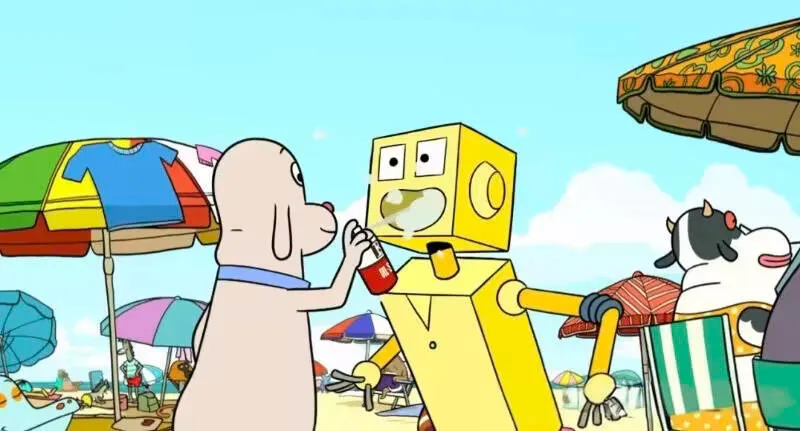
<p>Let us return to our epigraph: "The part of me that you changed will stand with me forever, in your place." At the film's end, though they ultimately part ways, both have drawn ample nourishment for growth from this intimate bond, and both have left the most precious of imprints upon each other's lives:</p>
<p>On the beach, Dog prepared lubricant for the Robot in advance and kept him away from the seawater. Under a sky full of fireworks, the Robot took Raccoon's hand — and this time, his grip was just right.</p>
<p><img src="https://drablog.pages.dev/_astro/Robort_dream.KeWXTC5V_1xfcde.webp" alt="Still from Robot Dreams" /></p>
]]></content>
        <author>
            <name>Drag0nM</name>
            <uri>https://drablog.pages.dev/</uri>
        </author>
        <published>2025-05-28T00:00:00.000Z</published>
    </entry>
    <entry>
        <title type="html"><![CDATA[Serial Experiments Lain]]></title>
        <id>https://drablog.pages.dev/en/posts/serial-experiments-lain/</id>
        <link href="https://drablog.pages.dev/en/posts/serial-experiments-lain/"/>
        <updated>2025-05-28T00:00:00.000Z</updated>
        <summary type="html"><![CDATA[If you fall into darkness, you can only wait for your eyes to adjust]]></summary>
        <content type="html"><![CDATA[<blockquote>
<p>If you fall into darkness, you can only wait for your eyes to adjust</p>
</blockquote>
<p>About twenty years ago, <em>Serial Experiments Lain</em> premiered on TV Tokyo. Around the same time, Microsoft released Windows 98, Google had just been founded, and the Internet was barely taking shape. No one imagined that their lives would one day be threaded together by network cables, pierced open by ports, overturned by information. Overshadowed in its time by the similarly experimental <em>Neon Genesis Evangelion</em>, <em>Lain</em> entered my field of vision two decades later, carried by its opening theme, "Duvet."</p>
<p>In truth, even today, twenty years on — though I consume both soft and hard science fiction with ease, and came prepared for experimental animation — watching <em>Lain</em>, I was still thoroughly overwhelmed by its conceptual daring and intellectual depth. In the realms of film and anime, works this ahead of their time, this radical in their thinking, are vanishingly rare.</p>
<p>Before entering the main discussion, I want to offer a few words of caution to those interested in <em>Lain</em>: because of the nature of experimental animation, <em>Lain</em> the series is itself an experiment. Its richness of detail and extreme economy of dialogue are designed to keep the work in an open state, able to accommodate more interpretations, associations, and imaginings. For this very reason, some viewers outside the target audience may find it incomprehensible or even unwatchable. (To my eyes, this work contains many cult elements, so those uninitiated may not be able to accept it.) Treat it as having had a nightmare, and do not force yourself to continue — spend your finite time on what truly interests you.</p>
<hr />
<h2>Present Day, Present Time</h2>
<p>The story of Lain unfolds across three planes: the first is the world carried by physical, material bodies; the second is the world of the network, carried by fiber optic hardware; the third is the world of consciousness, where all things sense one another in mutual resonance.</p>
<p>If one were to explain this work in the simplest possible terms, it would be this: the girl Lain affixed several tabs of acid to herself, and everything is a hallucination. Truly. Two words sum up the entire series: "Fake," "Pale." The pallid imagery — everything is false. This work is less science fiction or suspense than it is philosophical horror. A story like psychedelic noise music. The indeterminate ending leaves more room for imagination; every ending is correct and every ending is wrong, because there is no true right or wrong in this world. In this respect, it succeeds — it has already successfully conveyed to me what it set out to convey. Transpose this dread into the world of today, and it loses nothing; on the contrary, it multiplies. A moment's reflection is enough to chill me to the bone. And this story is precisely a guide toward reflection, toward inquiry. Fortunately, I chose to study politics; at times like this, I can only silently recite Lin Zexu's lines — "For the good of the nation, I would sacrifice even my life; how could I shrink from danger for personal gain?" — to calm my heart. To probe the "self" is insoluble; it only plunges me into a vortex. To search for the self is the same as to search for the cosmos — follow that path of deep thought to the end, and it will drive you mad.</p>
<p>In the tedium of daily life, we are always forced to regard ourselves as existing entities. When the events of others enter our lives, we begin to care about the connections between us, to reexamine ourselves, and then to worry or rejoice over others' opinions of us. Lain, however, accepts the proposition that "a person exists within the memories of others." And so Lain accepts that she is a program, that her way of existing takes many forms, and she wishes to extend this thesis to Alice. For Lain, Alice is a special person, a bond — and in truth, she symbolizes all others.</p>
<p>But just as all convoluted false syllogisms are defeated in an instant, so the simplest, most ordinary phrases often possess a lethally destructive power: "Thump, thump" — the sound of a heartbeat. We are all living beings. Connected or not, existing or not, real or not — we all possess a heartbeat.</p>
<p>The true self is singular. All that talk of dual personalities and multiple personalities, of split selves and fragmented selves — every person condenses from many selves into one. Like those two circles I once imagined: as our understanding of the outer world expands infinitely, our understanding of ourselves contracts infinitely. Every facet of you is you. However many ways of existing there may be, it is still one life. Whoever's memory your existence depends upon, they all know only one you.</p>
<p>The outer circle's boundary is boundless; the inner circle's core grows increasingly refined — and at last, there is only stillness. This perhaps resonates, in some way, with Fei Xiaotong's concept of "differential patterns of association."</p>
<hr />
<h2>Future Day, Future Time</h2>
<p>Though one can glimpse from it, however partially, reflections on consciousness, on the direction and resistance of human evolution, on the ultimate questions of "Who am I? Where do I come from? Where am I going?" — here, through the lens of <em>Lain</em>, I also wish to consider the future shape of society and the relationship between humans and machines.</p>
<p>After the implementation of real-name policies, the Internet lost much of its mystery. Now, with economic globalization advancing, various financial and IT monopolies are gradually taking form — because this vastly increases efficiency. The pie keeps growing. Megacity afflictions worsen by the day; centers of power coalesce. During the Cold War, the United States designed the Internet — originally named ARPANET — to prevent its computers from being wiped out in a single strike. (The well-known server software Apache also derives its name from this lineage.) Why that name? When colonial invaders captured the Inca emperor, the empire quickly crumbled. But indigenous tribes were much harder to systematically eliminate. The purpose of inventing the Internet was decentralization, and so it was named after the last Native American tribe to surrender to the United States.</p>
<p>Perhaps it is precisely the anonymity of the network that allows people to do online what they could never do in daily life. In <em>Death Note</em>, there is an episode: after Light Yagami begins punishing criminals, though people are unwilling to express their true feelings publicly — voicing only relatively moderate opinions in the open — in private, and especially on the Internet, they wholeheartedly endorse this extreme method. Under the daily influence and control of government and major media, the collective is, to some degree, unconscious — or at the very least, merely drifting with the current.</p>
<p>In the earliest days, I believed it was possible that, in the future, supra-governmental organizations might form on the Internet. Just as early file downloads required a specific website, but later P2P, eD2K, and BitTorrent protocols enabled peer-to-peer transfers without a central server — as long as someone still held the resource, there was no need to panic about the server hosting it being shut down. Even later, the emergence of virtual currencies in the real world, led by Ethereum and Bitcoin, pushed reality a giant step further in this direction — no central bank needed to regulate and issue currency, transactions completed directly. Perhaps in the future, anyone with a device will be able to exchange information. When people begin plotting unimaginable things online, this is a subversion of traditional social forms.</p>
<p>Later, as books deepened my understanding of society, it seemed that individual profit-seeking and collective development are perpetually at odds, and so those earlier notions — the entire subject, even — were shelved. To this day, I still feel I lack the capacity to continue that discussion.</p>
<p>Now, with the second explosion of generative artificial intelligence and robotics, the conversation about human-machine relations has once again been placed upon the table. Yet, aside from the early, robot-targeted Asimovian solution of the "Three Laws of Robotics," humanity seems to have forgotten about itself.</p>
<p><strong>Adding to the human.</strong> The most influential work in this vein is <em>Ghost in the Shell</em>. A robot's mode of thinking can grow ever more human, and a human can become as indestructible as a machine. Artificial organs, mechanical limbs — this is already achievable, and it is nothing less than a form of evolution. The problem that follows is the collapse of ethics and the very motivation for human existence. At the end of the day, humans are biological organisms. The two most fundamental properties of a living being are: reacting to external stimuli — that is, the will to survive; and producing offspring capable of reproduction — that is, sexual desire. These two things have brought me so much suffering, and yet I remain alive to this day — only to enjoy those fleeting moments of pleasure. The imprint of the biological is indelible. As for what robots might think, we cannot predict. But once humans no longer rely on hormones for their responses, once they are fully converted into bodies of steel — what meaning remains in living? Reproduction would be nothing more than generating another copy. Where would the distinction between human and machine lie?</p>
<p><strong>Subtracting from the human.</strong> I had thoughts along this line even before watching <em>Lain</em>; afterward, my mind was blown wide open. As long as the dream never ends, you believe you are in the real world. As a line from the anime puts it: "If the relevant memories are erased, one can say that event never happened." The current trend in information storage is toward ever smaller physical volumes with ever greater capacity. What if the human body could be entirely removed, leaving only the mind and the carrier that houses it, stored within a sufficiently secure container, requiring only minimal energy, or capable of absorbing energy from the outside world? If it could move, if humans could interconnect — that would be even better. Just as the loss of desire can bring tranquility, and abandoning all hope can bring equanimity, humanity's interaction with the world has two great attributes: understanding nature and transforming nature. If we largely give up on transforming nature, we come to understand it more. Words are written on paper; data is stored on disks. Can information exist without a carrier? If it could, we could replicate our own information, penetrate every corner of the cosmos, and form a unified whole. Such an act would be virtually indistinguishable from godhood. I like liveliness — but I prefer to watch it from a distance.</p>
<p>Let me close with a line from <em>Saya no Uta</em>: "Is it because reproduction has become too effortless? As a result, humans produced love. In another sense, the concept of love could be said to hinder biological reproduction. If, in nature, mutual affection were required to bring forth the next generation, I fear over ninety percent of species would vanish. Given that, must the beloved of a human being — encumbered by love — also be human? So long as the soul is pure, does outward form matter so little? Does so-called love ultimately arise from the spiritual, or from the physical?" Then my own question is this: like reproduction itself, does the meaning of human civilization's development lie solely in preserving its own civilization while exporting its civilization and values as far as possible?</p>
]]></content>
        <author>
            <name>Drag0nM</name>
            <uri>https://drablog.pages.dev/</uri>
        </author>
        <published>2025-05-28T00:00:00.000Z</published>
    </entry>
    <entry>
        <title type="html"><![CDATA[To Live]]></title>
        <id>https://drablog.pages.dev/en/posts/to-live/</id>
        <link href="https://drablog.pages.dev/en/posts/to-live/"/>
        <updated>2025-05-28T00:00:00.000Z</updated>
        <summary type="html"><![CDATA[A swan song of an era: weeping in the manner of laughter, living toward death]]></summary>
        <content type="html"><![CDATA[<blockquote>
<p>A swan song of an era: weeping in the manner of laughter, living toward death</p>
</blockquote>
<p>Like the novel, the film is oppressive from beginning to end — an oppression that grows only heavier as Fugui's life appears to improve, seeping into the heart through the most ordinary of words. I wish it were a bad film, as if that would somehow allow us to bury or even forget history. But it is a brilliant film, and it drives that oppression deep into my soul — even now, as I write these words, the epithet "capitalist-roader" still echoes in my mind.</p>
<p>As with <em>In the Heat of the Sun</em>, I will set aside discussion of craft and technique for another time, when I am better equipped. Let me speak of content instead — and of what I wish to vindicate.</p>
<p>I have read a number of reviews. Some say it falls short of other films on the same subject. Some say it fails to foreground the tragedy of the era — that it reflects personal tragedy more than historical tragedy, and is therefore insufficiently profound. Some say it is too tender, lacking the dark side of human nature. Some say it does not truly capture what "to live" means.</p>
<p><strong>To those who say it fails to foreground the tragedy of the era</strong>, I reply: only through personal tragedy can the tragedy of an era be told.</p>
<p>Yes — Youqing's death, Fengxia's death — each loss seems, on the surface, a personal tragedy. Fugui and Jiazhen are forever haunted by regret: if only they had not sent Youqing to school that day, if only they had not given Professor Wang so many steamed buns and so much water. But I doubt any viewer overlooks this: Youqing went to school because the school was smelting steel; Youqing fell asleep against the wall because the Great Leap Forward's steel campaign had utterly exhausted him. Fengxia died because the hospital had been overrun by students, because Professor Wang had not eaten in three days. No one in the film questions the era. No one questions whether the Great Leap Forward or the Cultural Revolution might be wrong. Think about that. Is this not precisely the truth of that time? The terror of that era lay not in the impossibility of resistance, but in the numbness — the inability to even recognize that one's misfortune was the fault of the age, the numbness of never realizing one ought to resist at all.</p>
<p><strong>To those who say it is too tender</strong>, I reply: only with great joy can there be great sorrow.</p>
<p>Yes — at first I too assumed a subject like this must inevitably involve cannibalism, earth-shattering tragedy, twisted and sinful humanity. Yet none of that appears. From beginning to end, the film is suffused with tenderness, even humor. Long'er is not a villain who turns his back on old friends; he gives Fugui a chest of shadow puppets. Chief Niu is not a tyrannical cadre; he preserves Jiazhen's thermos and Fugui's puppets. Chunsheng is not a climber who abandons his roots for success; he is deeply, tormentedly remorseful for having killed Youqing. Erxi is not a Red Guard drunk on revolutionary fervor; he seeks out the denounced Professor Wang to save his wife. This is not like those stories that plunge headlong into unrelieved tragedy, that would cry out, "From that day on, his face never again knew laughter." Instead, it feels more real, more shattering. No one's life is truly composed of nothing but misfortune, with no moment of joy. Human beings are stubbornly resilient creatures. Even when time cannot fully erase the scars on the heart, most of the time we still choose to keep living. Having lost a son, and then a daughter as well, you would expect Fugui and Jiazhen — the white-haired burying the black-haired — to be crushed beyond recovery. Yet Zhang Yimou does not show us that. He shows us the old couple bringing their son-in-law and grandson to visit the graves, sharing a meal, commenting that Professor Wang now eats only rice and not noodles — but rice is more expensive than noodles. You wonder: how can they speak so casually, so lightly, about the man who failed to save their daughter? But perhaps that is exactly how it is. Because there is a grandson, still innocently asking innocent questions. Because there is a dutiful son-in-law. Because the old couple still have each other to lean on. Sustained by these small, fragile threads of warmth, they carry on — haggling over firewood, rice, cooking oil, salt, soy sauce, vinegar, and tea. To live — that is all it is.</p>
<p><strong>To those who say it does not truly capture what "to live" means</strong>, I reply: to my eyes, this film is the perfect embodiment of those two words.</p>
<p>Chief Niu says: fire those three cannons at Taiwan — one onto Chiang Kai-shek's bed, one onto his dining table, one onto his latrine — so he cannot sleep, cannot eat, cannot shit, and Taiwan will be recovered. Sleeping, eating, shitting — whoever you are, to live is nothing more than this. None of us are the protagonists of that soul-stirring opera <em>Farewell My Concubine</em>. Most of us cannot change the times. Most of us haggle over trivialities — firewood and rice — yet we can still find happiness in small things, and bring happiness to those around us. Most of us are this humble, and yet this tenaciously alive.</p>
]]></content>
        <author>
            <name>Drag0nM</name>
            <uri>https://drablog.pages.dev/</uri>
        </author>
        <published>2025-05-28T00:00:00.000Z</published>
    </entry>
    <entry>
        <title type="html"><![CDATA[KaTeX Mathematical Demo]]></title>
        <id>https://drablog.pages.dev/en/posts/katex-mathematical-demo/</id>
        <link href="https://drablog.pages.dev/en/posts/katex-mathematical-demo/"/>
        <updated>2025-04-01T00:00:00.000Z</updated>
        <summary type="html"><![CDATA[KaTeX is a cross-browser JavaScript library that displays mathematical notation in web browsers. It puts special emphasis on being fast and...]]></summary>
        <content type="html"><![CDATA[<p>KaTeX is a cross-browser JavaScript library that displays mathematical notation in web browsers. It puts special emphasis on being fast and easy to use. It was initially developed by Khan Academy, and became one of the top five trending projects on GitHub.</p>
<h2>Group Theory</h2>
<p>Burnside's lemma, sometimes also called Burnside's counting theorem, the Cauchy-Frobenius lemma or the orbit-counting theorem.</p>
<p>Let $\wedge$ be a group action of a finite group $G$ on a finite set $X$. Then the number $t$ of orbits of the action is given by the formula.</p>
<p>$$
t=\frac{1}{|G|}\sum_{g\in G}|\text{Fix}(g)|
$$</p>
<p>For each integer $n\ge2$, the quotient group $\mathbb{Z}/n\mathbb{Z}$ is a cyclic group generated by $1+n\mathbb{Z}$ and so $\mathbb{Z}/n\mathbb{Z}\cong\mathbb{Z}_n$.</p>
<p>The quotient group $\mathbb{R}/\mathbb{Z}$ is isomorphic to $([0,1),+_1)$, the group of real numbers in the interval $[0,1)$, under addition modulo 1.</p>
<p>Isomorphism Theorem. Let $\phi\colon(G,\circ)\to(H,*)$ be a homomorphism. Then the function</p>
<p>$$
\begin{aligned}
f\colon G/\text{Ker}(\phi)&amp;\to\text{Im}(\phi)\
x\text{Ker}(\phi)&amp;\mapsto\phi(x)
\end{aligned}
$$</p>
<p>is an isomorphism, so</p>
<p>$$
G/\text{Ker}(\phi)\cong \text{Im}(\phi)
$$</p>
<h2>Taylor's Theorem</h2>
<p>Let the function $f$ be an $(n+1)$-times differentiable on an open interval containing the points $a$ and $x$. Then</p>
<p>$$
f(x)=f(a)+f'(a)(x-a)+\cdots+\frac{f^{(n)}(a)}{n!}(x-a)^n+R_n(x)
$$</p>
<p>where</p>
<p>$$
R_n(x)=\frac{f^{(n+1)}(c)}{(n+1)!}(x-a)^{n+1},
$$</p>
<p>for some $c$ between $a$ and $x$.</p>
<p>$\KaTeX$ doesn't have a right-align option so an extra aligned column is used for equation numbers. They are pushed to the right by mkern spacing, default \mkern100mu. Both align &amp; align* environments can be used, as can \tag and \notag.</p>
<h2>Align environment</h2>
<p>$$
\begin{align}
\frac{\pi}{4n^2} &amp;= \frac{4^n(n!)^2}{2n^2(2n)!}n(2n-1)J_{n-1}-\frac{4^n(n!)^2}{2n^2(2n)!}2n^2J_n \tag{1} \
&amp;= \frac{4^n}{4(2n)!}\left(\frac{n!}{n}\right)^22n(2n-1)J_{n-1}-\frac{4^n(n!)^2}{(2n)!}J_n \tag{$\ddagger$} \
&amp;= \frac{4^{n-1}((n-1)!)^2}{(2n-2)!}J_{n-1}-\frac{4^n(n!)^2}{(2n)!}J_n \tag{2}
\end{align}
$$</p>
<h2>Align* environment</h2>
<p>$$
\begin{align}
\frac{4^N(N!)^2}{(2N)!}J_N &amp;\leq \frac{4^N(N!)^2}{(2N)!}\frac{\pi^2}{4}\frac{1}{2n+2}I_{2N} \tag{*} \
&amp;= \frac{\pi^2}{8(N+1)}\frac{4^N(N!)^2}{(2N)!}I_{2N} \
&amp;= \frac{\pi^2}{8(N+1)}\frac{\pi}{2} \tag{**} \
&amp;= \frac{\pi^3}{16(N+1)} \
\frac{x}{\sin x} &amp;\leq \frac{\pi}{2} \tag{3} \
\text{so} \qquad\qquad x &amp;\leq \frac{\pi}{2}\sin x \tag{4}
\end{align}
$$</p>
<h2>Sum of a Series</h2>
<p>$$
\begin{align*}
\sum_{i=1}^{k+1}i &amp;= \left(\sum_{i=1}^{k}i\right) +(k+1) \tag{1} \
&amp;= \frac{k(k+1)}{2}+k+1 \tag{2} \
&amp;= \frac{k(k+1)+2(k+1)}{2} \tag{3} \
&amp;= \frac{(k+1)(k+2)}{2} \tag{4} \
&amp;= \frac{(k+1)((k+1)+1)}{2} \tag{5}
\end{align*}
$$</p>
<h2>Product notation</h2>
<p>$$
1 + \frac{q^2}{(1-q)}+\frac{q^6}{(1-q)(1-q^2)}+\cdots
= \prod_{j=0}^{\infty}\frac{1}{(1-q^{5j+2})(1-q^{5j+3})},
\text{ for }\lvert q\rvert &lt; 1.
$$</p>
<h2>Cross Product</h2>
<p>$$
\mathbf{V}_1 \times \mathbf{V}_2 = \begin{vmatrix}
\mathbf{i} &amp; \mathbf{j} &amp; \mathbf{k} \[1ex]
\frac{\partial X}{\partial u} &amp; \frac{\partial Y}{\partial u} &amp; 0 \[2.5ex]
\frac{\partial X}{\partial v} &amp; \frac{\partial Y}{\partial v} &amp; 0
\end{vmatrix}
$$</p>
<h2>Maxwell's Equations</h2>
<p>$$
\begin{align*}
\nabla \times \vec{\mathbf{B}} -, \frac1c, \frac{\partial\vec{\mathbf{E}}}{\partial t} &amp;= \frac{4\pi}{c}\vec{\mathbf{j}} \
\nabla \cdot \vec{\mathbf{E}} &amp;= 4 \pi \rho \
\nabla \times \vec{\mathbf{E}}, +, \frac1c, \frac{\partial\vec{\mathbf{B}}}{\partial t} &amp;= \vec{\mathbf{0}} \
\nabla \cdot \vec{\mathbf{B}} &amp;= 0
\end{align*}
$$</p>
<h2>Greek Letters</h2>
<p>$$
\begin{align*}
&amp;\Gamma\ \Delta\ \Theta\ \Lambda\ \Xi\ \Pi\ \Sigma\ \Upsilon\ \Phi\ \Psi\ \Omega\
&amp;\alpha\ \beta\ \gamma\ \delta\ \epsilon\ \zeta\ \eta\ \theta\ \iota\ \kappa\ \lambda\ \mu\ \nu\ \xi\ \omicron\ \pi\ \rho\ \sigma\ \tau\ \upsilon\ \phi\ \chi\ \psi\ \omega\ \varepsilon\ \vartheta\ \varpi\ \varrho\ \varsigma\ \varphi
\end{align*}
$$</p>
<h2>Arrows</h2>
<p>$$
\begin{align*}
&amp;\gets\ \to\ \leftarrow\ \rightarrow\ \uparrow\ \Uparrow\ \downarrow\ \Downarrow\ \updownarrow\ \Updownarrow\
&amp;\Leftarrow\ \Rightarrow\ \leftrightarrow\ \Leftrightarrow\ \mapsto\ \hookleftarrow\
&amp;\leftharpoonup\ \leftharpoondown\ \rightleftharpoons\ \longleftarrow\ \Longleftarrow\ \longrightarrow\
&amp;\Longrightarrow\ \longleftrightarrow\ \Longleftrightarrow\ \longmapsto\ \hookrightarrow\ \rightharpoonup\
&amp;\rightharpoondown\ \leadsto\ \nearrow\ \searrow\ \swarrow\ \nwarrow
\end{align*}
$$</p>
<h2>Symbols</h2>
<p>$$
\begin{align*}
&amp;\surd\ \barwedge\ \veebar\ \odot\ \oplus\ \otimes\ \oslash\ \circledcirc\ \boxdot\ \bigtriangleup\
&amp;\bigtriangledown\ \dagger\ \diamond\ \star\ \triangleleft\ \triangleright\ \angle\ \infty\ \prime\ \triangle
\end{align*}
$$</p>
<p><em>Samples taken from <a href="https://sixthform.info/katex/examples/demo.html">KaTeX Live Demo</a></em></p>
]]></content>
        <author>
            <name>Drag0nM</name>
            <uri>https://drablog.pages.dev/</uri>
        </author>
        <published>2025-04-01T00:00:00.000Z</published>
    </entry>
</feed>