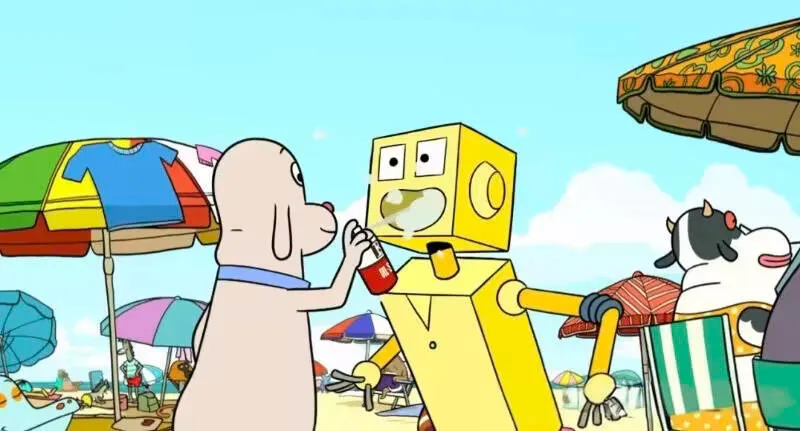
Robot Dreams
The part of me that you changed will stand with me forever, in your place
On March 11, 2024, at the 96th Academy Awards ceremony in Los Angeles, Hayao Miyazaki’s The Boy and the Heron took home the Oscar for Best Animated Feature. Among the nominees was Robot Dreams, adapted from Sara Varon’s graphic novel of the same name. On Douban, however, the two films’ standings could hardly be more opposite.
Of the source material, Pablo Berger — who had never directed an animated film before — said: “I had never cried reading a graphic novel before, and in that moment, I thought: I have to turn Sara’s book into an animated film.”
He succeeded.
And so, what follows is a personal dissection of this animated children’s film made for adults.
Why is Robot Dreams so rich in meaning?
Compared to other animated films, Robot Dreams possesses one particularly striking feature — it contains not a single line of dialogue. If language carries emotion, as the most straightforward vehicle of emotional expression, then Robot Dreams, as a color silent film, conveys emotion to us even more directly through the characters’ expressions and gestures. It is precisely by stripping away the subjective mediation of language itself, by presenting emotion directly before your eyes rather than confining it with words, that the film achieves its remarkable interpretative richness. In the eyes of ten thousand viewers, there may well be ten thousand versions of Robot and Dog.
Moreover, unlike romantic films that often conclude with didactic or summarizing lines of dialogue, the elision of language in this film, combined with its interpretative openness, adds a layer of ineffable emotion at the ending — one that can only be savored, long and silently, in the depths of the heart.
In keeping with animated film convention, Robot Dreams chooses a dog and a robot as its protagonists. Animals and robots are perennial favorites of children’s animation — for their cuteness, their magical quality, and other such reasons. But viewed through this film’s lens, there is another way to understand this choice: it is by this very means that the film completely erases the two characters’ gendered characteristics. The director maximizes the species difference between the two leads as much as possible, and adopts a Chaplinesque silent-film style — all of which suggests he does not want the audience to apply the ready-made frameworks of human society — lovers, best friends, brothers — to crudely and reductively define this naturally blossoming, beautiful connection, thereby obscuring what the film truly wishes to explore: the nature of intimate relationship itself. As a result, the bond between the two can be interpreted in multiple ways — it may be seen as romantic love, or understood as friendship. The different perspectives from which the content unfolds thus produce the rich interpretability mentioned above.
What is Robot Dreams about?
If you watch Robot Dreams closely, you will discover that beneath its surface theme — shared with films like Love Me If You Dare, La La Land, and We Made a Beautiful Bouquet, the theme of “a broken mirror not mended” — there lies an immense narrative archetype called “intimate relationship.”
When watching the aforementioned films of this type, we often merely lament the caprices of fate and the cruelty of circumstance; few of us seek to understand the magnitude of emotional transformation experienced by those living inside the story. What sets Robot Dreams apart is that, through the dual perspectives of one dog and one robot, it grants us the chance to inhabit their experience — to feel the wordless heartbreak and reluctance when an intimate bond is forcibly severed.
Everything about this film is hidden within these few dreams
After their separation, the Robot has three dreams, and these three dreams seem to represent the stages of emotional change one undergoes after being forced apart.
The First Dream: The Robot dreams of breaking free from the beach and finding the door to Dog’s apartment. Just at the moment of knocking, the dream shatters. He thought three rabbits had kindly come to his rescue, but upon waking he discovers they are savagely sawing off his leg and prying off his toes to patch their boat — his first visceral lesson in the cruelty and danger of the outside world. This dream represents bewilderment. After a sudden separation from someone you love, the very first feeling is confusion and disbelief — doubting that any of this is real, believing it is only a matter of having lost each other by accident, and that once you find the other, this bond can continue.
The Second Dream: Dog has forgotten him and found a new robot — and this newcomer bears him ill will. He can only hide, flustered, embarrassed, sorrowful, behind a trash can, as though he, too, has become a piece of refuse no one cares for. In just a few expressions, the Robot runs the gamut from shock to disbelief to heartbreak. I believe this dream represents terror. After a period of waiting, realizing that the other truly does not want to come back for you — then comes the shock, the fear, the heartbreak. Shock that a bond you thought could never break has reached its end. Fear that a “newer, better” presence will replace you. Heartbreak that while you are still waiting and searching in anguish, the other has long since cast you from their mind.
The Third Dream: Spring sunshine, a rainbow suspended high, flowers dancing around the Robot in celebration, forming a procession in the shape of the protagonist. This time, the Robot is utterly convinced he will reunite with Dog — but reality plays yet another colossal trick on him. The entire city is nothing but a false backdrop. When it collapses with a roar, the ultimate contrast of light and dark, warmth and cold, truth and illusion declares that the Robot has now sunk into deep despair and fear. This dream represents the desolation that comes after accepting the outcome.
Everything has settled. Though the other still appears in dreams, though those tender moments still return in sleep, it is all nothing more than yesterday’s phantoms. The beautiful sunlight and music bring only a fleeting solace within the dream; when the dream ends, reality is as cold as ever.
At the same time, while the Robot struggles through separation, Dog, too, endures the pain of parting.
The new companion in this dream is the Snowman, whom Dog has given life to. The Snowman is a born star — everywhere he goes, he is the center of attention, while Dog, by contrast, is unwelcome. This Snowman is an inverse projection of Dog’s inner self. In life, Dog is withdrawn, insecure, and lacking in confidence, afraid to speak to strangers, locking the door of his apartment with multiple bolts. The Snowman’s image seems to be what Dog longs for — a desire to bid farewell to his former self and become an ideal, better person. And yet, the Snowman’s face, in the end, transforms into the Robot’s.
This also suggests that, through his shared life with the Robot, Dog’s way of thinking has been changed. The days spent with the Robot brought sunlight into his gray existence, and he gradually became someone who lives more positively.
And after the Robot awakens from his dream, a mother bird comes to him. He watches her bring new life into the world, and toward this new life — especially that one differently colored little bird — the Robot extends the same careful nurture that Dog once showed him when teaching him how to live. Later, when he finds a new companion, he remembers how he once gripped Dog’s hand too tightly by accident, and so holds his new companion’s hand all the more gently. Beautiful love, in truth, is like this: it is not that I could not live a single second without you, but that because of you, I have become a better version of myself.
Both of these deeply moving relationships in the final two dream sequences are variations upon the bond between Dog and Robot.
Just as the title Robot Dreams suggests — dreams do not last forever. And this film shows us what comes after waking: how to carry those beautiful memories forward and live a better life. This is what elevates it above other films that share “intimate relationship” as their narrative archetype. It does not merely depict the dissolution of an intimate bond; it chooses, with even greater scope, to elaborate on the story that comes after the separation. It leads us into the depths of memory, to look back at those passersby who left their footprints upon our fickle fates, and to see how, through love and companionship, they forged the unique individuals we are today.
Why couldn’t Dog rescue the Robot?
Children’s animated films tend to render their characters in flat, simplified strokes — what are generally called “flat characters.” Creators often seize upon a character’s animal traits and exaggerate or distort them to streamline personality, making it black or white. Whether in Tom and Jerry or Zootopia, this approach is the norm. Unusually, Robot Dreams preserves its characters’ basic animal natures while choosing to complicate them, infusing them with the fullest possible measure of humanity. So, beyond Dog’s tail-wagging when excited and his reliance on smell to find the Robot, we rarely see him display the raw animality of a dog. On the contrary, his patterns of thought, his behavioral modes, and his emotional expressions are all remarkably close to those of a human being. As director Pablo Berger said in an interview: “In a lot of animated films, the way characters act or react is very exaggerated. I wanted to dial it down and have the characters perform truthfully, like real people.”
What could clearly have been an avoidable accident becomes, like all the joys and sorrows of this world, a matter of fate’s gears not always meshing and turning precisely as one wishes. More often than not, it is through a succession of near misses and crossed signals that we, along with our loved ones and dearest friends, are pushed in different directions by fate’s invisible hand, drifting further and further apart until we fade from one another’s lives entirely. But is that truly the case? Perhaps it is precisely the personality traits revealed in the details that make this accident not merely contingent but inevitable.
The first time Dog takes the Robot out, they encounter some punk rockers. Faced with the Robot’s warm greeting, the youngsters reply with a middle finger. Afraid of trouble, Dog drags the Robot away in a panic. In the chaotic subway station, where fare evasion is rampant, Dog still insists on buying a ticket before entering. On the bus, Dog gingerly takes a snack from his bag, afraid of displeasing the driver…
Detail after detail points to a personality that is cautious, timid, sensitive, and rule-abiding. And it is precisely this personality that precipitates their first separation. So, to facilely brand Dog with labels like “didn’t love the Robot enough” or “fickle” is a shallow judgment; it cannot be denied that Dog poured genuine effort into this intimate bond. After all, not everyone has a god’s-eye view. He is like any ordinary person caught in an intimate relationship crisis in the human world — what looks to an outside observer like “not enough” may, for him, have been “everything I had.”
Likewise, at the film’s end, the two parallel threads of fate intertwine once more. The Robot sees Dog, just across the street, with his new companion. Memories of days gone by flood his mind, and he has one last waking dream: dashing down the stairs, racing into the street, embracing Dog. Once, he would have done exactly that. But now he has a new body, a new family — and Dog, too, has new companionship. So, after the dream fades, he chooses to press play. Accompanied by that familiar theme song, he dances one last duet with Dog — across the distance, across the street.
As the director has said, Robot Dreams is not a children’s film. Only those who have truly experienced loss can bear the weight of this bittersweet ending.
Beyond the review
There is a viewpoint that goes: “The relationship between Dog and Robot was inherently unequal. Robot was a commodity Dog purchased to relieve boredom — an accessory — while Dog was Robot’s entire world. Such a relationship predetermined the outcome of their separation. Perhaps Dog was already using the maximum of his capacity to love, but the purposefulness of the relationship determined the result.”
I hold a diametrically opposite view of what this argument describes. It is precisely this inequality in the relationship that demonstrates the depth of their intimate bond, rather than proving the relationship’s limits.
Consider this detail from the film: riding on a bus, the Robot sees one of his own kind in another vehicle, being “mistreated” by a child. The battered face and clouded eyes make it clear that this robot has not been treated kindly. This detail underscores a truth: in this animal city, robots remain commodities, property, appendages of others. Once they enter different households, they can only submit to the butcher’s block of fate — and clearly, not every robot is so fortunate.
Dog, by contrast, never treated the Robot as a tool to fill a void, but as an independent individual, equal in standing. Seen in this light, the bond between them is all the more touching, all the more precious.
Final words
Let us return to our epigraph: “The part of me that you changed will stand with me forever, in your place.” At the film’s end, though they ultimately part ways, both have drawn ample nourishment for growth from this intimate bond, and both have left the most precious of imprints upon each other’s lives:
On the beach, Dog prepared lubricant for the Robot in advance and kept him away from the seawater. Under a sky full of fireworks, the Robot took Raccoon’s hand — and this time, his grip was just right.